

Collaborative Inspection and Joint Clearance
“Collaborative Inspection and Joint Clearance” Mode
To further enhance passenger experience and clearance efficiency, the Huanggang Port will, based on the co-location arrangement, implement the novel “collaborative inspection and joint clearance” mode.
Under this new clearance mode, the two governments will set up automated channels/counters side by side within their respective jurisdiction at the boundary line inside the port. When using the automated channels, passengers will only need to queue up once for document inspection and identity verification to pass through the immigration facilities of both sides to complete respective immigration procedures.
In conjunction with the co-location arrangement, clearance time at the Huanggang Port would be significantly reduced from around 30 minutes at the existing Lok Ma Chau/Huanggang Control Point to approximately 5 minutes.
Immigration Clearance for Passengers
“Collaborative Inspection” Automated Channels
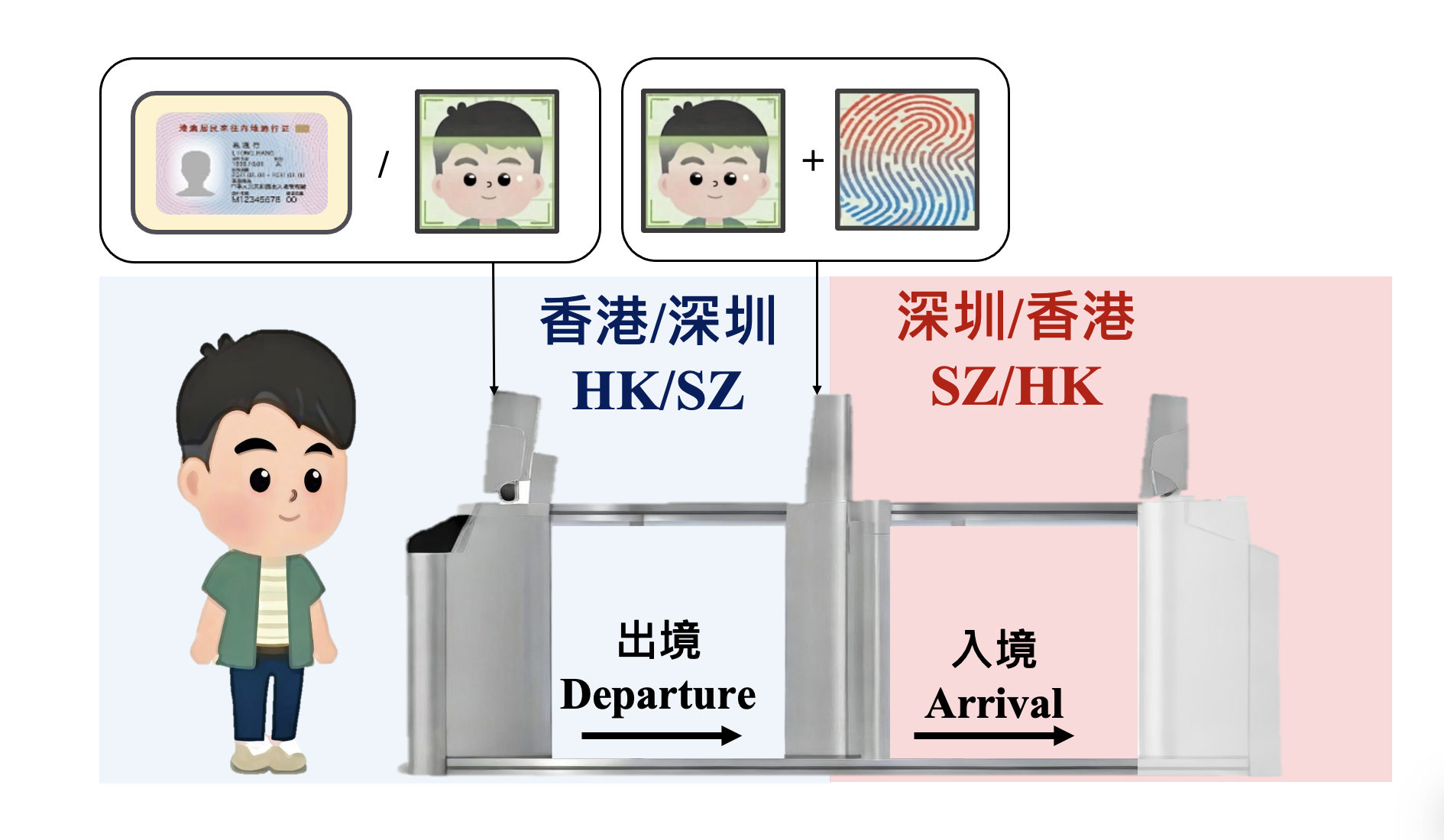
“Collaborative inspection” automated channels at the Huanggang Port would operate with both document presentation (“document reading” clearance) and document-free (“face scan” clearance) clearance modes. The “document reading” clearance is similar to the use of existing Hong Kong e-Channels, while the “face scan” clearance is a new service introduced under the “collaborative inspection” automated channels.
Usage Flow
| Clearance Mode | Usage Flow | Eligible Persons |
|---|---|---|
 “Document Reading” Clearance
|
|
|
 “Face Scan” Clearance
|
|
|
“Document Reading” Clearance – Presentation Arrangement of Travel Document
Eligible persons can pass through the first gate of the “collaborative inspection” automated channels by presenting the following travel documents under the “document reading” clearance:
| Users | Northbound Travel to Mainland | Southbound Travel to Hong Kong | |
|---|---|---|---|
| Hong Kong Residents | 1. Holding Hong Kong Permanent Identity Card and Mainland Travel Permits for Hong Kong and Macao Residents | Hong Kong Permanent Identity Card or Mainland Travel Permits for Hong Kong and Macao Residents |
|
| 2. Holding Hong Kong Permanent Identity Card and Mainland Travel Permits for Hong Kong and Macao Residents (Non-Chinese Citizens) | Hong Kong Permanent Identity Card or Mainland Travel Permits for Hong Kong and Macao Residents (Non-Chinese Citizens) |
||
| 3. Holding Hong Kong Identity Card and Mainland Travel Permits for Hong Kong and Macao Residents | Hong Kong Identity Card or Mainland Travel Permits for Hong Kong and Macao Residents |
||
| 4. Holding Hong Kong Identity Card and Exit-entry Permit for Travelling to and from Hong Kong and Macao | Exit-entry Permit for Travelling to and from Hong Kong and Macao | ||
| Mainland Visitors | 5. Holding Exit-entry Permit for Travelling to and from Hong Kong and Macao | Exit-entry Permit for Travelling to and from Hong Kong and Macao | |
Remarks:
1. Mainland Travel Permit for Hong Kong and Macao Residents commonly known as Home Return Permit
2. Exit-entry Permit for Travelling to and from Hong Kong and Macao commonly known as Two-way Exit Permit
Enrolment Methods and Procedures
Eligible persons may enrol for the use of the “collaborative inspection” automated channels and/or “face scan” clearance services through the following methods:
- Contactless e-Channel mobile application
- Collaborative inspection” automated channels / “Joint one-stop” vehicle lane (applicable upon departure from Hong Kong)
- Self-service Kiosks
- e-Channel Enrolment Offices
For details and eligible persons of the above enrolment methods, please refer to the latest announcements on the Hong Kong Immigration Department website (https://www.immd.gov.hk/cijcpec_hkt).

Traditional Manual Counters
The inbound and outbound authorities will set up traditional manual counters side by side along the boundary line. Passengers will only need to queue up once and present their valid travel documents separately to the outbound and inbound authorities to complete the respective immigration procedures.
Clearance for Vehicles/Drivers
Cross-boundary passengers generally need to disembark and proceed to the immigration clearance hall for on-board passengers (for passengers of private cars) or the passenger clearance hall (departure) (for passengers of cross-boundary coaches) to undergo passenger clearance procedures. Meanwhile, drivers will drive their vehicles into the “joint one-stop” vehicle lane, where the drivers will undergo a “five-party inspection” arrangement.
Cross-boundary Vehicles Departing Hong Kong for Shenzhen (L1)
After arriving at the L1 vehicle departure level, cross-boundary vehicles will first reach the “customs front kiosk”. Hong Kong Customs and Excise Department will conduct risk assessment and decide whether inspection is required. Vehicles may then follow the instructions and proceed directly to the “joint one-stop” vehicle lane or the inspection area for further inspection.
There are three gates at the “joint one-stop” vehicle lane. When the vehicle reaches the lane, the vehicle may enter directly if the first gate is open. If there is a vehicle being processed in the lane, the first gate will be closed. Please wait for the first gate to be opened upon completion of processing the vehicle in the lane.
Upon the vehicle’s arrival at the second gate, the driver will complete the collection of body temperature, travel document, facial features and fingerprints through the “integrated information collection device” installed next to the vehicle lane. Once the Hong Kong Immigration Department confirms completion of immigration clearance, and the Shenzhen inspection authorities confirm the collection of the driver’s information, the second gate will open.
The vehicle will then proceed to the third gate. Shenzhen inspection authorities will confirm the completion of the immigration procedures and decide whether vehicle inspection is required. Instructions will be given to the driver and the third gate will then open.
Cross-boundary Vehicles Arriving Hong Kong from Shenzhen (L3)
Once an inbound vehicle arrives at the first gate of the “joint one-stop” vehicle lane at L3, Shenzhen General Station of Exit and Entry Frontier Inspection will confirm the vehicle’s eligibility for passage and Shenzhen Customs will confirm the completion of customs clearance. The first gate will open after the confirmation.
Upon the vehicle’s arrival at the second gate, the driver will complete the collection of body temperature, travel document, facial features and fingerprints through the “integrated information collection device” installed next to the vehicle lane. Once the Shenzhen inspection authorities confirm the completion of outbound clearance procedures, and the relevant Hong Kong departments confirm the collection of the driver’s information, the second gate will open.
At the third gate, the Hong Kong Customs and Excise Department will conduct risk assessment to determine whether the vehicle is required to undergo inspection; the Department of Health will confirm whether an inspection is required; and the Hong Kong Immigration Department will confirm the completion of immigration clearance and that the visitors have collected their landing slips (if applicable). If inspection is required, instructions will be issued on the display screen. The third gate will open after receiving the driver’s acknowledgement.
Finally, the vehicle will leave the “joint one-stop” vehicle lane. The vehicle should follow the corresponding instructions to proceed to the inspection area for inspection, or proceed directly to the “rear gate” to leave the port. When the vehicle arrives at the “rear gate”, the gate will open once it is confirmed that the vehicle has completed all clearance procedures.
Eligibility of “Joint One-stop” Vehicle Lane
The self-service immigration clearance service of the "joint one-stop" vehicle lane applies to:
- Hong Kong residents holding a Hong Kong permanent identity card or Hong Kong identity card, as well as a Mainland Travel Permit for Hong Kong and Macao Residents or Mainland Travel Permit for Hong Kong and Macao Residents (Non-Chinese Citizens);
- Hong Kong residents holding a Hong Kong identity card and an Exit-Entry Permit for Travelling to and from Hong Kong and Macao; or
- Mainland visitors holding an Exit-Entry Permit for Travelling to and from Hong Kong and Macao with a valid exit endorsement for travelling to Hong Kong.
Quarantine Arrangements
The Department of Health enforces relevant provisions of the Prevention and Control of Disease Ordinance and the International Health Regulations at the seaports, Hong Kong International Airport and land boundary control points of Hong Kong, so as to prevent infectious diseases from being introduced into or carried away from the territory.
Similar to the existing arrangement in other boundary control points, the Department of Health has set up facilities, such as thermal imaging systems and isolation facilities, and deployed personnel to provide quarantine clearance service to travellers in the Huanggang Port Hong Kong Port Area. Under the “five-party inspection” arrangement at the “joint one-stop” vehicle lanes, drivers can have their body temperature checked using the “integrated information collection device”. Suspected cases of infectious disease will be referred to medical facilities for follow-up.
To promote and protect the health of travellers, the Department of Health displays and distributes health information materials at the boundary control points.
Personal Data and Privacy
For travellers using the “collaborative inspection” automated channels and the “integrated information collection device”, the outbound authority will collect passengers’/drivers’ travel document data as well as facial features and fingerprints for exit inspection, and with the consent of the relevant passengers/drivers, transmit the collected data to the inbound authority for entry inspection simultaneously. The immigration authorities of Hong Kong and Shenzhen will only compare the collected data against their respective databases, with no exchange or sharing of databases or inspection results.
To safeguard personal data and privacy, the relevant departments have engaged independent consultants to conduct privacy impact assessments, with a view to ensuring that the system design and operational workflows comply with the Personal Data (Privacy) Ordinance. The relevant departments also conduct independent information technology security risk assessments and audits to ensure system security.